Detailed Description
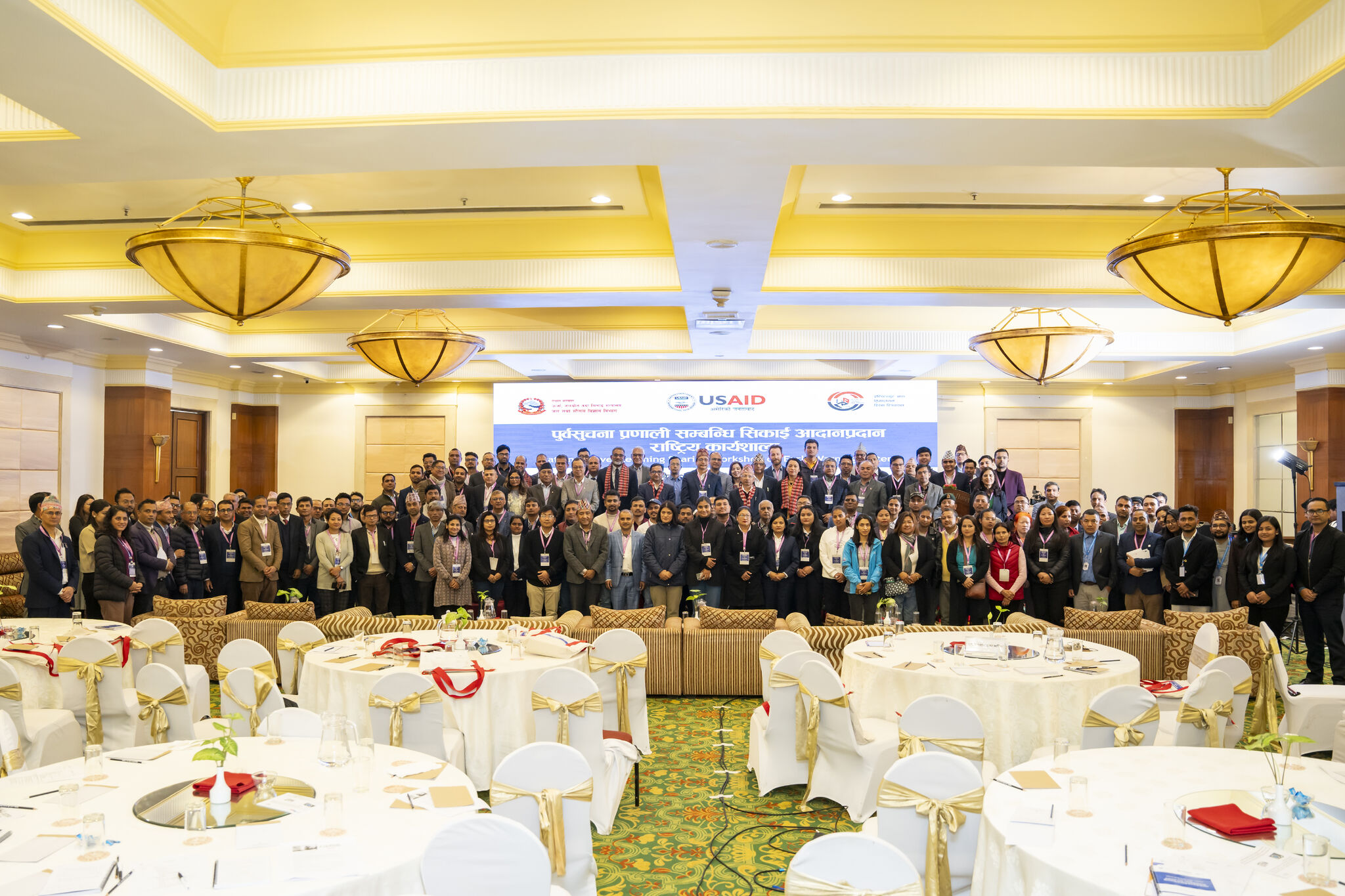
The National Workshop on Early Warning System for Disaster
Preparedness was held on 21st March 2024 in the Everest Hotel,
as part of the National Water and Meteorology Week,
commemorating World Water Day and World Meteorology Day. The
workshop was inaugurated by Hon. Minister of MOEWRI, Mr. Shakti
Bahadur Basnet, who emphasized the critical importance of
enhancing Nepal's early warning systems (EWS) to better prepare
for and respond to disasters. The event was organized by the
Department of Hydrology and Meteorology (DHM) and the Institute
of Himalayan Risk Reduction, with the aim of fostering
collaboration among key stakeholders in disaster risk reduction
(DRR).
The workshop drew a diverse group of 221 participants, including
government officials, private sector representatives,
development partners, and community stakeholders. Participants
were engaged through a variety of activities, such as technical
presentations, rapid-fire ‘lightning sessions,’ and a Gallery
Walk showcasing innovative technologies and research in EWS. The
workshop's thematic sessions were structured around the four key
pillars of EWS: disaster risk knowledge, detection and
monitoring, warning dissemination, and preparedness and response
capabilities.
The primary objective of the workshop was to exchange technical,
technological, and managerial knowledge, skills, and experiences
related to EWS. Participants were encouraged to share insights
and best practices, explore frontier technologies, and discuss
ways to demonstrate the impact of EWS innovations. The
activities facilitated dynamic exchanges, with participants
presenting impactful ideas and case studies, furthering the
understanding of EWS and its role in disaster preparedness.
The workshop concluded with several key learnings, including the
need for stronger community involvement, tailored solutions for
local needs, and sustained investment in EWS infrastructure. The
importance of inclusive EWS which prioritizes vulnerable groups,
as well as effective communication and collaboration among
diverse stakeholders, was emphasized. Participants agreed that
these efforts are crucial for building resilience, enhancing
disaster preparedness, and minimizing the impact of future
disasters.
Recorded Video of Workshop:
Watch the Webinar on YouTube